

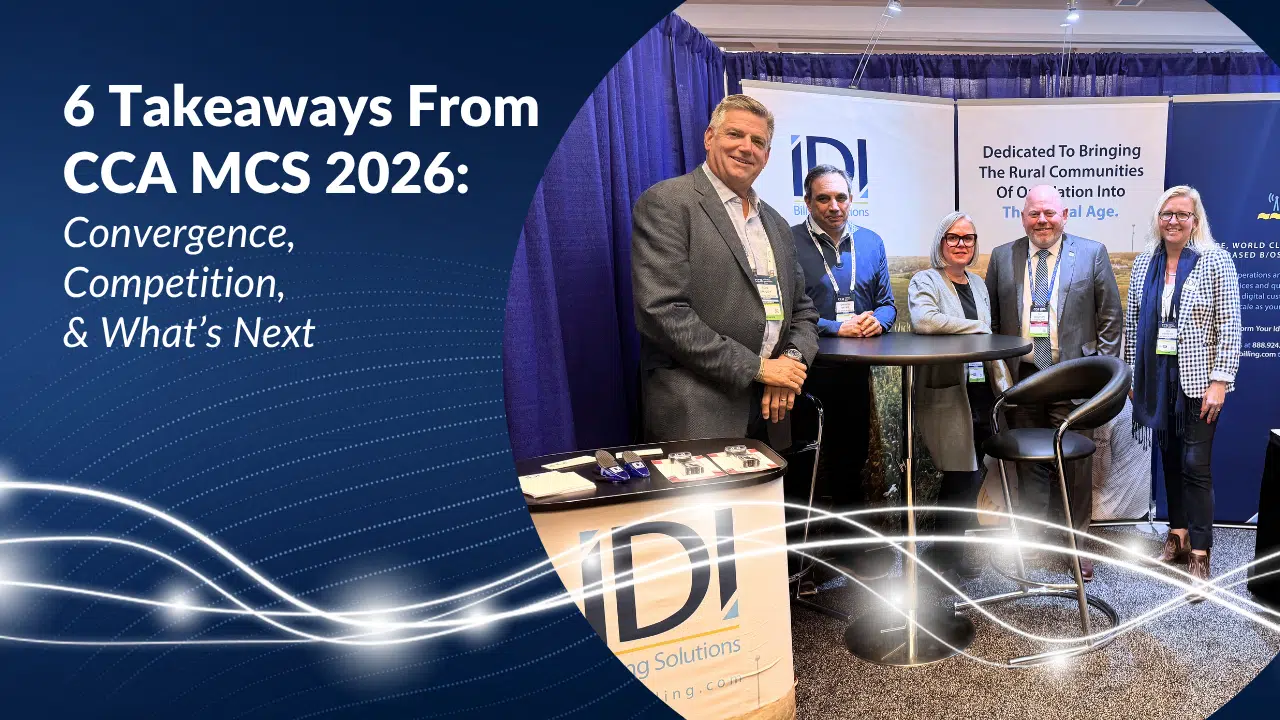

Insights from Ron Whaley, Chief Revenue Officer
A Pulse Check On A Changing Industry
Earlier this month, I had the opportunity to attend the Competitive Carriers Association (CCA) Mobile Carriers Show in Louisville, Kentucky – one of the most important events of the year for regional and rural communications providers.
As both an attendee and a member of the CCA Board of Directors, I always view this event as more than just a tradeshow. It’s a chance to connect with peers, hear directly from carriers, and get a real sense of where the industry is heading.
This year, one theme came through loud and clear: the definition of a “carrier” is changing…fast.
Here are six takeaways that stood out to me and will shape how carriers think about growth moving forward.
1. The Era of the “Mobile-Only” Carrier Is Over
One of the most consistent messages I heard, reinforced by leaders from Appalachian Wireless, Nex-Tech Wireless, and C Spire, is that carriers are no longer just mobile providers.
They’re becoming full-service connectivity providers. That includes:
- Expanding fiber networks
- Investing in infrastructure beyond wireless
- In some cases, even acquiring construction capabilities to accelerate deployment
This isn’t just about growth. It’s about staying competitive.
Convergence isn’t a strategy anymore. It’s the baseline.
2. Convergence Will Separate Leaders From The Rest
Closely tied to that shift is a broader reality that came up in multiple conversations and sessions.
The providers who embrace convergence, and figure out how to operationalize it, are the ones who will continue to grow. Those who don’t will face increasing pressure, and in many cases, consolidation.
Across discussions on private networks, rural broadband expansion, and evolving service models, it’s clear the industry is moving toward more integrated delivery across:
- Wireless
- Fiber
- Fixed wireless
- Enterprise and private network offerings
From a customer standpoint, none of that complexity matters. They expect a seamless experience – and carriers are being pushed to deliver it.
3. Policy Still Shapes The Playing Field
Policy continues to play a critical role in shaping how competitive carriers operate.
From keynote discussions to sessions focused on funding programs and interconnection frameworks, there was a clear focus on:
- The future of USF and BEAD funding
- Ongoing regulatory pressures
- The importance of maintaining a level playing field for rural operators
One thing that stood out to me is how important it is for carriers to stay engaged.
Having a seat at the table and building strong relationships with policymakers isn’t optional. It’s essential to long-term success.
4. Satellite Is No Longer “Emerging” — It’s Here
Satellite connectivity was a major topic throughout the event, including dedicated sessions on how satellite and mobile networks are beginning to converge.
What’s changed is the mindset.
Carriers are no longer watching this from a distance. They’re actively thinking about how to incorporate satellite into their broader strategy – whether that’s through partnerships, coverage extension, or resiliency.
I had several conversations with carriers who are starting to view providers like SpaceX, Lynk, and AST not as competitors, but as complementary partners.
5. AI Is Moving From Concept To Practical Application
AI was another topic that came up across multiple tracks, particularly in operations and network management.
What stood out wasn’t the hype. It was the focus on practical application.
Sessions highlighted real-world use cases around:
- Workflow automation
- Reducing operational friction
- Improving network performance
- Enhancing customer experience
The conversation has clearly shifted. It’s no longer “What could AI do?” … it’s “Where can we apply it today to drive real results?”
And for many carriers, the next step is figuring out how to operationalize it within their existing environments.
6. Partnerships Continue To Be A Core Strength
One of the things I’ve always appreciated about the CCA community is how relationship-driven it is.
That hasn’t changed.
Rural and regional carriers rely heavily on their partners, not just for technology, but for ideas, guidance, and support as they navigate a rapidly evolving landscape.
That dynamic was on full display again this year.
As the industry becomes more complex, those partnerships are only becoming more important.
What It All Means
If I had to sum up this year’s event in one sentence, it would be this:
The carriers who succeed will be the ones who adapt – and execute.
They’ll embrace convergence.
They’ll leverage partnerships.
They’ll modernize their operations to support new service models.
And ultimately, they’ll position themselves to deliver the kind of experience their customers expect.
Building A Better Experience – At Scale
One thing that really stood out to me throughout the week is that growth today isn’t just about expanding services, it’s about how well you deliver them.
Carriers are taking on more. More network types, more partners, more complexity. But at the end of the day, the expectation from customers hasn’t changed. They want a seamless, reliable experience.
And that’s not easy to deliver in a converged environment.
It requires a platform that can bring everything together – unify operations, support new service models, and give teams the flexibility to move quickly without creating friction behind the scenes.
That’s exactly where we’re focused at IDI.
We’ve built our platform to help providers manage that complexity and turn it into an advantage…not something that slows them down.
If you’re thinking about what comes next, I’d welcome the dialogue.
Give us a call at 800.208.6151 or connect with us here to schedule a conversation and see how we’re helping providers build a better experience.